
The Allergen Documentation Pack a Value Fragrance Line Needs Before Shipping
An allergen declaration is one line on a label, supported by a small stack of documents that almost nobody assembles until a market asks for it. A value line needs that stack before the first shipment rather than before the first complaint, because the documents come from different parties and each one has a lead time. Seven items are enough to make the file defensible, and every one of them should have a named owner and a version.
Key takeaways
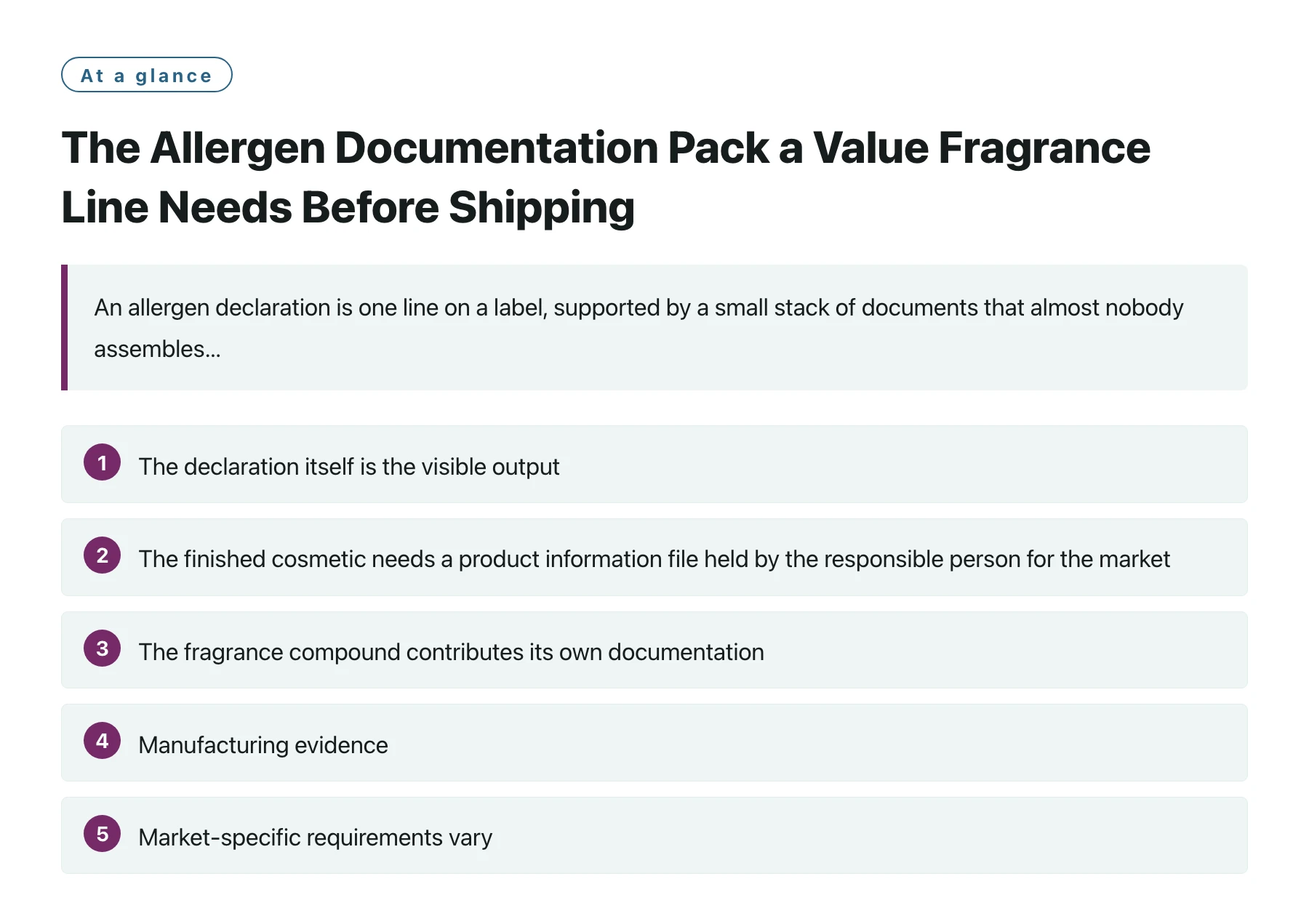
- The declaration itself is the visible output; the file behind it is what makes the declaration verifiable.
- The finished cosmetic needs a product information file held by the responsible person for the market, and that role has to be arranged rather than assumed [1].
- The fragrance compound contributes its own documentation, including the substance information that feeds the label declaration.
- Manufacturing evidence, such as the batch record and the site's cosmetics GMP position, ties the shipped goods to the approved formula.
- Market-specific requirements vary, so a pack assembled for one destination has to be reviewed before it is reused elsewhere [3].
- Safety assessments are reviewed as knowledge develops, which means the pack is maintained rather than completed [2].
- The most common failure is not a missing document but a missing version reference, which makes a valid document unusable for a specific order.
Compliance files tend to be built backwards. A brand ships, a distributor asks a question, and the team assembles documents under time pressure from whoever answers the phone. On a value line this happens more often, because the range is wider, the suppliers change and the pack is refreshed regularly.
This article describes the seven items that make up a workable allergen documentation pack and the order in which they should be collected. It is written for the person who has to produce the file, which on a small brand is usually the founder.
The seven items, in the order they should be collected
- 1. Formula-level allergen declarationA substance list in reference nomenclature, tied to a formula version and showing the applicable concentration or threshold position. This is the document the label is derived from.
- 2. Fragrance compound documentationThe safety and standards information that comes with the concentrate, including the evidence that the compound meets the restrictions applicable to the product category.
- 3. Safety assessment for the finished productA qualified assessor's evaluation of the finished cosmetic, which considers the formula, the pack, the use pattern and the intended market. It belongs to the responsible person, not to the factory.
- 4. Product information fileThe compiled file held for the market, which contains the safety report and the supporting data. It has to be available to authorities on request, and it has to be kept current.
- 5. Manufacturing evidenceThe batch record for the shipped goods and the site's cosmetics GMP position, which together connect the delivery to the approved formula and process.
- 6. Testing reportsStability, compatibility and microbiological reports that name the formula version, container, closure and storage conditions. A report without those four references does not apply to a specific order.
- 7. Label content and proofThe approved ingredient and allergen text, plus a printer's proof checked against it, so that the shipped carton matches the file rather than the design mock-up.
Who owns what in the pack
The documents in the list come from at least four parties: the fragrance supplier, the filling manufacturer, the safety assessor and the brand. Clarity about ownership is what keeps the pack current, because a document that has no owner is a document that is only produced when someone asks.
The brand's own responsibilities are the ones most often underestimated. The brand chooses the markets, which determines the applicable rules and the notification route. The brand defines the claims, which the safety assessment has to support. The brand decides the pack and the fill size, both of which affect the assessment. Delegating all of that to a manufacturer is possible, but it has to be a deliberate arrangement rather than an assumption.
Where a perfume factory in China supplies the concentrate and a different company fills the product, the declaration may be issued by one party and relied upon by another. In that structure the brand should hold the declaration itself, along with the version reference that ties it to the concentrate used in the batch. Relying on a chain of emails to reconstruct that link two years later is the failure mode this whole exercise is designed to avoid.
The pack also needs a review trigger. Any change to the formula, the pack, the supplier or the market list should prompt a check, and the check should be recorded even when the answer is that nothing changed. A short log of reviews is far more useful in a market query than a confident statement that the file is fine.
The document that gets forgotten
It is usually the printer's proof. The label is treated as a design deliverable and the approved allergen text as a detail inside it, so no one compares the final print against the declaration. A signed proof check takes minutes and closes the loop between the formula and the carton, which is exactly the link a market authority will test.
Keeping the pack usable when the line grows
A value line grows by addition: a new size, a new scent, a seasonal variant. Each addition inherits most of the pack and changes a little of it, and the temptation is to copy the folder and adjust the label. That works only if the version references are updated at the same time, because a declaration copied with the folder will point to the wrong formula.
The workable habit is to treat the pack as a set of references rather than a set of files. Each order should be traceable to a formula version, a pack version and a declaration version. Where a supplier can deliver that traceability as part of its normal documentation, the brand's workload drops sharply, and it is a reasonable thing to ask for when comparing manufacturers. A producer that describes one-stop fragrance manufacturing as its model is claiming that compound and filling sit together, which usually makes the traceability simpler; the follow-up question is whether that structure is used for your specific format and volume.
Growth also brings market growth. Adding a country is not a labelling change alone; it may bring a different notification route, different label language and a different responsible person arrangement. Reusing a pack across markets without checking is the most common way a compliant product becomes non-compliant in a new territory, and the check is cheap when the file already exists in a structured form. Buyers who are choosing a producer at the same time can use what to check before choosing a perfume factory to test whether documentation discipline is part of how a candidate works, rather than something it adds on request.
Finally, keep the pack separate from the marketing archive. Files stored with artwork and campaign assets get renamed, moved and lost when teams change. A compliance folder with a version index survives staff turnover, which is the event that most reliably breaks an informal system.
A simple test of readiness for a first shipment: if a distributor asked for the allergen declaration, the safety assessment and the batch record for one specific order, could you send all three within a day, each with a version reference? If the answer is no, the gap is a process gap rather than a paperwork gap, and it is much cheaper to close now than during a market query.
Sources
- European Commission: Cosmetics in the EU —— The European Commission's overview of EU cosmetics rules, including the responsible person, product information file and safety report requirements.
- EU Scientific Committee on Consumer Safety (SCCS) —— The EU scientific committee that issues opinions on the safety of cosmetic ingredients, including fragrance allergens and their labelling thresholds.
- Health Canada: Cosmetic Safety —— Health Canada's cosmetics pages, covering cosmetic notification, the ingredient hotlist and safety requirements for cosmetics sold in Canada.
Frequently asked questions
Does the fragrance manufacturer or the brand hold the allergen documentation?
Both hold parts of it. The manufacturer or compound supplier provides the substance information and manufacturing evidence. The brand, or a responsible person acting for it, compiles the product file and holds the safety assessment. The split should be written into the supply agreement.
How long should compliance documents be kept?
Long enough to cover the product's time on the market plus the period required by the markets where it is sold. In practice that means keeping files for years rather than months, with the version references that connect a specific order to a specific formula.
Can one documentation pack cover several markets?
The core technical documents usually can, because they describe the product. The label content, notification route and responsible person arrangement are market-specific and have to be reviewed separately for each destination.
What should be checked before reusing a pack for a new size?
The fill size, the pack compatibility, the safety assessment and the declaration reference. A new size is a new pack version, and the assessment has to cover the format as sold, not only the formula.
Is a batch record really necessary for allergen labelling?
It is what connects the declaration to the goods that shipped. Without it, a file describes a formula in the abstract; with it, the file can answer the only question that matters in a query, which is what was actually in this order.
Root your children in classical, Christ-centered learning.
Join 2,347 families who trust Agape to disciple the next generation — without choosing between academic rigor and biblical faithfulness.