
Jewelry OEM Manufacturing: Six Steps and Three Documents
The published OEM/ODM flow has six steps: inquiry, consultation and development, CAD and prototype, sample and approval, bulk production, then final QC and delivery. Three documents hold that flow together: the tech pack, the CAD sign-off and the sample approval record. Without them, a 48-hour CAD stage and a 25–30 day sample run on memory rather than on a written brief.

Key takeaways
- The published flow runs six steps from inquiry to 100% inspected delivery.
- The CAD step is under 48 hours, about 6.7–8% of the sampling window.
- Master sampling takes 25–30 days and bulk production 21–28 days.
- Three documents carry the order: tech pack, CAD sign-off, sample approval record.
Six steps, three documents
The six steps are a sequence of handovers. Each one passes a defined output to the next, and each output is either written down or lost.
Inquiry takes the brief. Consultation and development turns it into a feasible specification with a material and a cost structure. CAD and prototype produces the file and the renderings for dimensional sign-off.
Sample and approval produces the physical master. Bulk production scales the approved sample, and final QC and delivery inspects 100% of pieces before packing and shipping.
A jewelry OEM ODM partner that issues the same three documents on every project is easier to manage than one that improvises, because the buyer can see which step is open and who owes the next input.
The tech pack sets what the factory can quote
The tech pack is the first document and the quickest to correct. It carries the sketch or reference photos, the dimensions that matter, the base material, the target finish and any logo or hallmark requirement.
A thin tech pack produces a quote with assumptions inside it. The factory guesses the material, guesses the plating and guesses the clasp, and the sample arrives with three decisions the buyer did not make.
A useful pack is short but specific. It states the metal, the finish family, the stone list, the chain or finding type and the packing format. Each item maps to one of the six customisation areas the process publishes.
The published support terms shorten the loop around it. A 24-hour response and a dedicated project manager mean a thin pack can be queried within a day rather than a week, and the answers land in the file before CAD starts.
The pack should also state what is flexible. A buyer who writes "silver, 18K gold plating, 40 cm chain, no stones" has given the factory enough to quote without a meeting, and has left the shape open for the CAD stage.
The 48-hour CAD sign-off
CAD is published at under 48 hours and includes realistic renderings so the buyer can confirm proportions before metal is cut. Those two days are the last point where a change costs a file edit rather than a mould.
The sign-off should confirm five things: overall dimensions, thickness at the thinnest section, stone seat depths, attachment geometry and the position of the hallmark or logo. Each is visible in a rendering or a drawing, and each is expensive to change later.
The timing arithmetic is worth keeping in view. Two days against a 30-day sample is 48/720 = 6.7%, and against 25 days it is 48/600 = 8%. The stage is small in calendar terms and decisive in cost terms.
ISO 9001:2015 supports the discipline by asking for controlled information at each production stage. In practice that means the signed revision is identifiable, and the tooling is cut from the revision that was signed rather than the one before it.
Revision control is the quiet benefit. If a change is requested after sign-off, the earlier revision stays on file, so the tool can be traced to the drawing that authorised it and the change can be quoted as a defined piece of work.
The sample approval record, and the packaging decision
The sample arrives at 25–30 days and is the third document. It should record what was approved, what was noted for the next run and what was left unchanged, because production is built from that record rather than from the conversation around it.
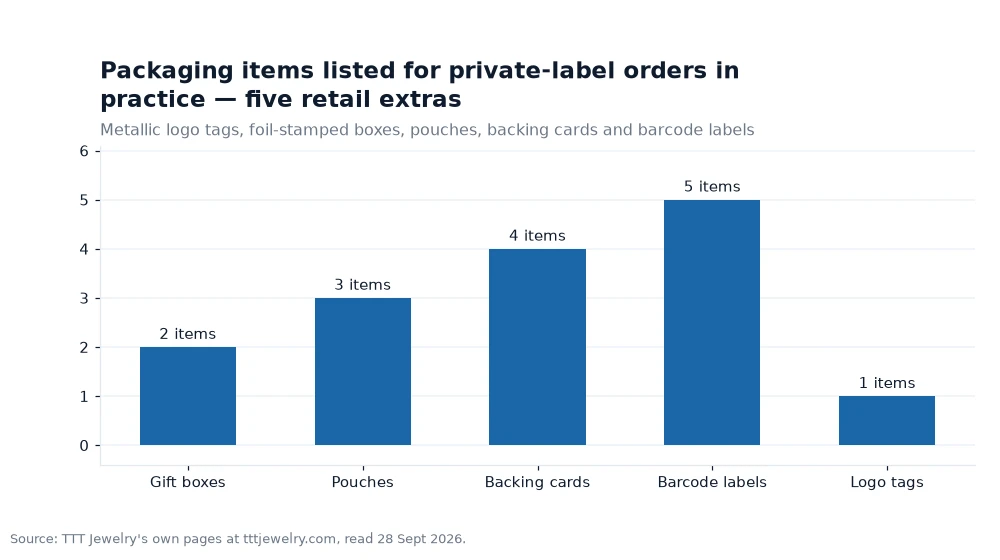
This is also the point to settle packaging, which is the specification most often deferred. The published list includes metallic logo tags, foil-stamped gift boxes, velvet or microfiber pouches, display backing cards and barcode labelling.
Packaging interacts with the piece. A backing card with fixed slot spacing constrains the bail, and a barcode label needs a flat area on the box or the tag. Deferring the decision to the packing table turns a design problem into a delay.
| Document | Issued at | What it freezes |
|---|---|---|
| Tech pack | Inquiry | Material, dimensions, finish target, packing format |
| CAD sign-off | CAD and prototype, under 48 hours | Geometry, shrinkage, hallmark position |
| Sample approval record | Sample and approval, 25–30 days | Finish, colour, final packing |
Three rows, three gates. A project that skips one usually re-opens it later at a higher cost.
Worked example
A buyer issues a complete tech pack on day one. CAD takes 2 days, the sample takes 30 and production takes 28, so the order reaches delivery at 2 + 30 + 28 = 60 days, or 8.6 weeks. With a 25-day sample and 21-day production the same order takes 48 days, or 6.9 weeks.
Now add a ten-day approval delay at the sample gate. The 60-day cycle becomes 70 days, which is 10 weeks, and the launch moves with it. The factory stages did not change; the buyer's document did.
A second physical sample costs more than ten days. It adds 25–30 days, taking the total to 85–90 days, or 12.1–12.9 weeks. At the fast end, 85 days against a 48-day baseline is 77% more elapsed time for one extra round.
Packaging shows the same pattern in miniature. Five retail extras decided at the approval gate are five items specified once. Decided after production, they are five purchase orders running against a finished batch.
Frequently asked questions
What are the six steps of OEM/ODM manufacturing?
Inquiry, consultation and development, CAD and prototype, sample and approval, bulk production, then final QC and delivery, with the last step 100% inspected.
Which document should a buyer prepare first?
The tech pack. It carries the sketch, reference photos, dimensions, material and target finish that the factory needs to quote and to start CAD.
How long does approval add to the calendar?
Approval is the buyer's own step. The factory stages are 48 hours for CAD, 25–30 days for the sample and 21–28 days for production, so any delay in signing sits on top of 48–60 days.
Making the handovers visible
The value of the document set is not bureaucracy. It makes each handover visible, so a late decision is identified as a late decision rather than absorbed silently into the next stage.
It also makes a reorder cheap. The approved record already holds the finish, the packing and the hallmark position, and the custom jewelry wholesale route can reuse the mould and skip straight to production.
The factory direct manufacturing model keeps CAD, casting, plating and packing in one schedule, which is why the six steps can be promised as published windows rather than estimates.
Write the three documents, keep the revisions, and the six-step flow becomes a schedule a brand can plan around.
Source note: figures come from the manufacturer's own website (tttjewelry.com), read 28 Sept 2026.[1]